By utilizing appearance modifiers, you can further customize the appearance of your GuiObjects.
- Apply a gradient to the background of an object.
- Apply a stroke to text or a border.
- Set rounded corners for an object.
- Increase padding between the borders of an object.
- Add a drop shadow behind an object.
Gradient
The UIGradient object applies a color and transparency gradient to its parent GuiObject.


You can configure the gradient by:
- Choosing the gradient's starting point (inside or outside the parent's bounds) through the Offset property.
- Choosing the gradient's edge sampling behavior through the TileMode property.
Color sequence
To set a gradient's color sequence:
In the Explorer window, select the UIGradient.
In the Properties window, click inside the Color property field, then click the ⋯ button to the right of the input box.

Each triangle on the bottom axis of the color sequence is a keypoint that determines the color value at that point.
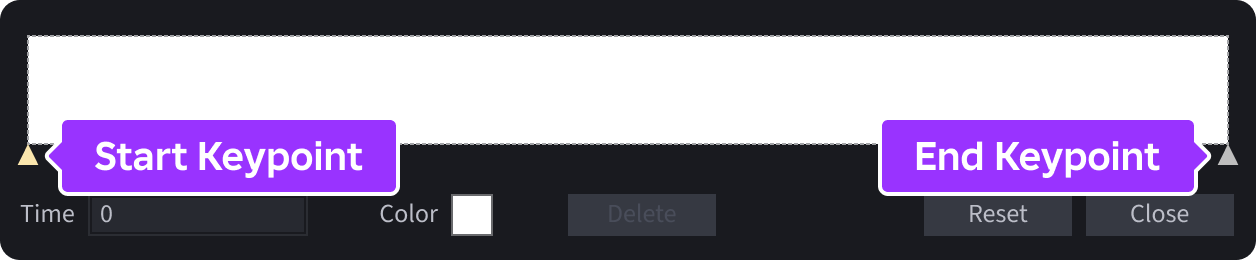
- Click a keypoint in the color sequence to select or reposition it, or add another keypoint by clicking anywhere on the graph.
- Click the small square next to Color to open the Colors pop-up window, then select the desired color for the keypoint.
- If needed, repeat these steps to add/adjust colors across the graph.


Transparency
To adjust a gradient's transparency across its range:
In the Explorer window, select the UIGradient.
In the Properties window, click inside the Transparency property field, then click the ⋯ button to the right of the input box.

Each square across the number sequence graph is a keypoint that determines the transparency value at that point.

- Click a keypoint in the number sequence to select or reposition it, or add another keypoint by clicking anywhere on the graph.
- Enter a specific time/value combination through the Time and Value inputs.
- If needed, repeat these steps to add/adjust transparency levels across the graph.


Type
A gradient's Type property sets its type from among Linear, Radial, Elliptical, or Conical.
Elliptical — The color/transparency sequence radiates outward from the element's center in an ellipse, optionally shifted by Offset. The ellipse's horizontal and vertical radii are half the element's width and height, so the ellipse fits the element's bounds. Rotation rotates the ellipse's axes.


Offset and rotation
The Offset and Rotation properties let you adjust the gradient's control points and its angle. As illustrated in the following diagrams, Offset is based on a percentage of the parent's width or height, and both positive or negative values are valid.


Similarly, when you rotate the gradient, the control points also rotate:


Scale
A gradient's Scale multiplies the extent of the gradient, controlling how much of the color/transparency sequence is visible within the element.
When Scale is greater than 1, the gradient spans more than the full extent and only a part of the color/transparency is visible.
For Elliptical gradients, Scale affects both radii of the ellipse.


Tile Mode
The TileMode property sets how the gradient repeats when the full sequence does not fully cover the parent element.
Clamp — Default mode where the color/transparency values at the start and end of the sequence extend infinitely, so the start values fill any area before the gradient and the end values fill any area after it.
Repeat — The gradient repeats by wrapping the color/transparency sequence tiles seamlessly from end back to start. This can produce a visible seam if the first and last color/transparency values in the sequence differ.
Mirror — The gradient reflects at each boundary so the color/transparency sequence ping‑pongs. This produces a smooth repetition with no seam, since the direction reverses at each tile edge.


Stroke
The UIStroke instance applies an outline to text or a border. Key features include:
- Ability to set the stroke transparency independently of the parent's transparency.
- Customizable position and/or offset relative to the parent's border.
- Three corner styles (round, bevel, or miter).
- Stroke gradient support through the UIGradient instance.
Thickness
You can set the stroke width through the Thickness property which is measured in pixels (default) or scaled relative to the parent, depending on the modifier's StrokeSizingMode. If stroke is on text and StrokeSizingMode is set to ScaledSize, thickness is relative to the font size.


Color or gradient
You can set the stroke color through the Color property, as well as insert a child UIGradient instance to create gradient strokes.


Text outline or border
Depending on its parent type, UIStroke operates as either a text outline or as a border. When you parent UIStroke to a text object like TextLabel, it applies to the text's outline; when you parent UIStroke to other GuiObjects, it applies to the border.


When applied to a text object, you can override the default stroke behavior by the ApplyStrokeMode property, letting you apply the stroke to the object's bounds instead of the text itself. You can even control the text outline and border independently by parenting two UIStroke instances to a text object, one set to Contextual and the other to Border.

Border position/offset
BorderStrokePosition sets the stroke's position relative to its parent's border and BorderOffset lets you specify an additional offset to the stroke's position.


Transparency
The Transparency property sets the stroke transparency independently of the parent object's BackgroundTransparency or TextTransparency. This allows you to render text and borders that are "hollow" (consisting of only an outline).


Corner style
The LineJoinMode property lets you control how corners are interpreted. It accepts a value of either Round, Bevel, or Miter.


Layering
To layer multiple sibling UIStroke instances on a GuiObject from front to back, you can utilize the ZIndex property. Those with a lower ZIndex render under (behind) those with a higher ZIndex.
Note that the rendering order for UIStroke instances with the same ZIndex is undefined. Do not apply multiple UIStroke instances with the same index if their rendering order matters.
Corners
The UICorner instance applies deformation to the corners of its parent GuiObject. You can control the applied radius through the CornerRadius property using either Scale or Offset.
Scale rounds the corners to a percentage based on the total length of the shortest edge of the parent, meaning that a scale of 0.5 or higher deforms the parent into a "pill" shape, regardless of its width or height. Offset rounds the corners to a specific number of pixels, regardless of the width/height of the parent.


You can also control individual corners through the TopLeftRadius, TopRightRadius, BottomRightRadius, and BottomLeftRadius properties.

TopRightRadius = (0, 48)
BottomRightRadius = (0, 48)
BottomLeftRadius = (0, 0)
Padding
A UIPadding object applies top, bottom, left, and/or right padding to the contents of the parent GuiObject. For example, you can move the text inside a text label downward or upward by applying an offset to the modifier's PaddingBottom property.


Shadow
A UIShadow object renders a shadow for its parent UI instance. A shadow can follow the parent's rectangular shape or the glyphs of a text object. Shape shadows can appear outside or inside the parent, and mask the area directly behind the parent. Both shape and text shadows can use a color gradient.
If the parent has a UICorner or a nonzero GuiObject.Rotation, its shape shadow follows the same corners or rotation. UIShadow doesn't support Path2D or textures.
Shape and text shadows
The Mode property determines what casts the shadow, and both modes can coexist under the same parent.
- Text follows the text glyphs of a TextLabel, TextButton, or TextBox. Other UI objects don't render a shadow in this mode.


Spread, Inset, and ShowBehindParent have no effect in text mode.
Blur
The BlurRadius property determines the shadow's blurriness. A larger value makes the shadow's edges appear softer. Note that the scale factor of this UDim property is relative to the parent's width or height, whichever is shorter.


Color and transparency
The Color property determines the shadow's color, while Transparency sets the shadow's transparency with 0 being fully opaque and 1 being fully transparent.


For a multicolor shadow, insert a UIGradient as a child of the UIShadow. The gradient affects the shadow without changing the parent's fill.

Offset and spread
The Offset property moves the shadow relative to the parent's position, while Spread expands or shrinks the shadow relative to the parent's size.


Inset shadows
Set Inset to true to render the shadow on top of and inside the parent instead of behind it. Positive Spread values expand an inset shadow toward the center of the parent.


Reveal content behind a transparent parent
By default, ShowBehindParent is true, so the entire shape shadow renders, including the portion directly behind the parent. Set it to false to mask that portion of the shadow. This prevents the shadow from darkening content visible through a transparent parent.


This property has no effect on inset or text shadows.
Layer shadows
Add multiple UIShadow instances to the same parent to combine effects. The ZIndex property controls their render order. Shadows with lower values render behind shadows with higher values.
The render order of shadows that share the same ZIndex is undefined. Assign each sibling shadow a different value when their order matters.